It’s an exciting time launching a new book. This book began its journey back in the era of Covid in 2020, when I signed the contract with Yale University Press to write a biography of Themistocles as part of their Ancient Lives series. At the time we agreed my writing of the book would need to wait a little as I was in the process of writing my X Marks the Spot: An Adventurous History of Archaeology book with Hodder and Stoughton. I started writing Themistocles in late 2022, building on the brilliant work of Ms. Kelsi Russell who had worked as a research assistant for me on the project while I was busy writing X Marks the Spot. But then early in 2023, it became clear I had a new deadline – my wife and I were expecting a son in the autumn. The first draft of the book was finished the week before our son Wilbur was born. Just for good measure, I also started a new job on the Executive board at the University of Warwick as Pro-Vice-Chancellor International in September 2023, which meant a much busier travel schedule and much less time for research. And because these kinds of things come in threes, my family and I moved house in the December of 2023. 2024 and 2025 are thus something of a blur: getting stuck into the new job; setting up a new home and most importantly spending amazing (if of course exhausting!) time with my family as my wife, my daughter and I got to know our newest member. I want to thank my wife and family, as well as the staff of Yale University Press, the anonymous readers and the Ancient Lives series editor James Romm, for their support and constant encouragement to progress this book from first draft to completed manuscript through that time. This book has probably had the longest gestation period of any I have written – but I think it has been worth it.
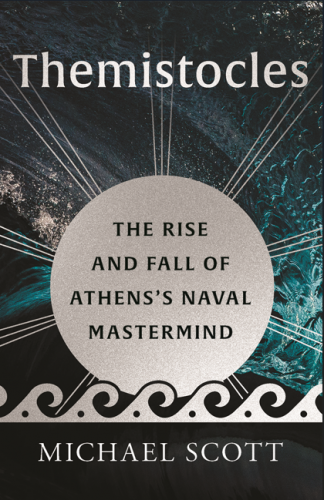
You will see in the acknowledgements of the book that I have dedicated it to my new born son Wilbur. This is not simply because he made his entrance into our family during the course of it being written. But as I was writing the book, it became clear to me that, alongside trying to unpick what we can know of Themistocles’ fascinating and rollercoaster life in ancient Athens, his story – and the different tellings of it there have been both in antiquity and modernity – was a lesson in how lives are really lived and how reputations made. The book begins with the assessment of Themistocles by the ancient historian Thucydides – that he was ‘the most illustrious Greek of his time’ (joint with one other!). So much of that assessment is attached to the particular role Themistocles played in Athens’ darkest hour during the Persian invasion of 480-79 BCE, and his leadership of the Athenians in pushing them both to build a large fleet and then subsequently to use that fleet to confront the Persians in the straits of Salamis. With the benefit of hindsight of course this looks a brilliant, ingenious and ‘illustrious’ move. But it is also a lesson in how lives and reputations can be hung on just a few actions. I wanted to understand more about Themistocles’ entire career and life – his motivations, his background, his beliefs.
Filming at the Straits of Salamis
What I found was a life and career full of more ups and downs than your average rollercoaster. Themistocles survived through multiples rises and falls in Athenian politics and civic life. His defining moments of ‘illustrious’ behaviour were at the time highly contentious and high risk. He ended his life exiled from Athens, condemned a traitor, living at the behest of the Persian kings he had defeated. And yet, post his death, circumstances conspired to revive his reputation and reposition him, through selective memorialisation of his deeds, as an Athenian and Greek hero.
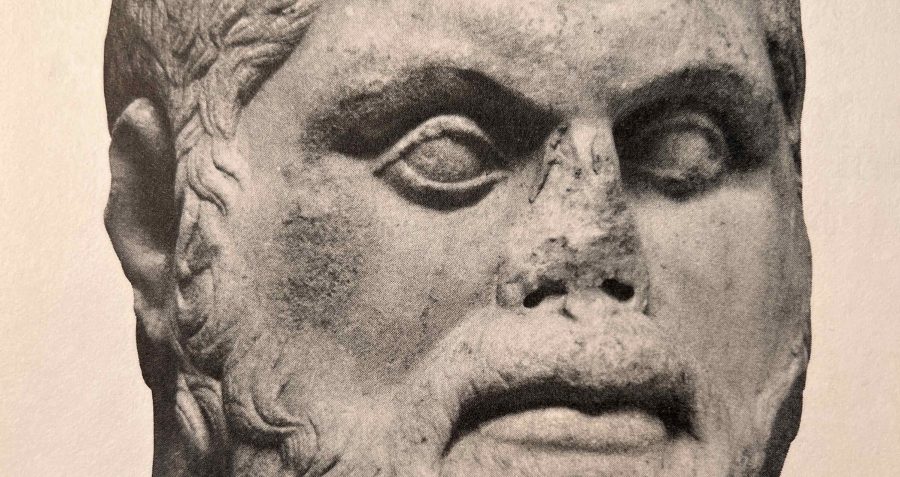
A surviving ancient portrait bust of Themistocles
There are thus two things I hope readers take from this book and that in due course my son Wilbur will learn from it. First is that no life is as ‘illustrious’ as it looks; no success as certain as it seems in hindsight. We look around us and are confronted continuously by examples of seemingly pre-destined and assured success. But that is not how life is lived and experience: it is a rollercoaster of uncertainty, ups and downs and us simply trying to make the best decision we can with the information available at the time. I hope very much that this book serves as a comforting reminder of that reality. Second, that no assessment of our lives is fixed. Themistocles’ reputation not only varied hugely during his lifetime, but in the decades after his death and to some extent through to today. We may in part feel unnerved by the feeling of such a thing as our reputation being (somewhat) out of our control. But that again is the reality – both in antiquity and today. I find that in an odd way comforting.
So enjoy the story of Themistocles’ extraordinary career, his rises and falls, his ups and downs, his gambles that came good as well as those that didn’t, his uncertain moments as well as his brilliant successes. And I hope that it brings you all, as well as one day my son Wilbur, the confidence to feel that life is unfolding in the glorious technicolour that it always has – and always will for us all.
Find our more about the book here: https://michaelscottweb.com/publications/themistocles-the-rise-and-fall-of-athenss-naval-mastermind/
You can purchase here from Yale University Press: https://yalebooks.co.uk/book/9780300256598/themistocles/
Themistocles: The Rise and Fall of Athens’s Naval Mastermind is available from 3rd February 2026.